


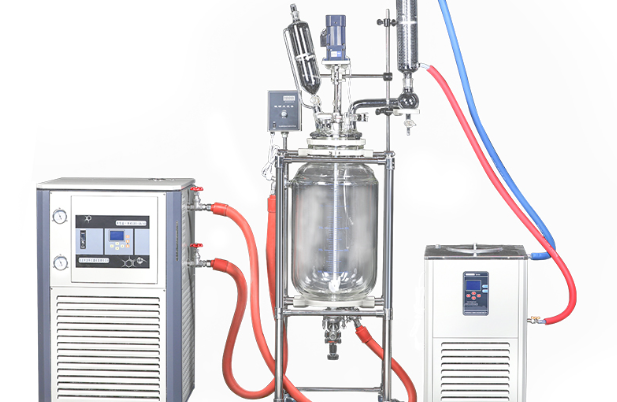
The rate of chemical reactions is usually related to temperature. In order to control the reaction rate and ensure product quality, precise temperature control of the reaction vessel is required during the chemical reaction process.
How important is temperature control of the reactor?
The China Chemical Safety Association has analyzed the causes of reactor explosions in fine chemical enterprises, and concluded that the accidental release of heat during the fine chemical reaction process is the most likely to cause reactor explosions and fires.
For example, when an accident occurs, the cooling system fails, and a large amount of reaction heat cannot be removed through the cooling medium, resulting in a continuous increase in system temperature; The reaction products decompose at high temperatures, leading to an explosion in the high-pressure reactor.
How to choose suitable temperature control equipment for the reaction kettle?
Suitable temperature control equipment must have a cooling power that matches the requirements of the reaction kettle. It can not only remove the heat generated by chemical reactions, but also achieve precise temperature control.
How to calculate the required cooling capacity for a reaction kettle?
The required cooling capacity for the reaction kettle consists of three parts:
1. The power required for cooling the sample inside the reaction vessel
According to physics formulas, the power required to cool the sample inside the reactor can be calculated based on the volume, density, specific heat capacity, as well as the cooling amplitude and time of the sample.
2. The power required for cooling the thermal conductive liquid in the bath, pipeline, and jacket layer
We know the specific heat capacity of the thermal conductive liquid, as well as the required cooling amplitude and cooling time. By calculating the mass of the thermal conductive liquid in the bath, pipeline, and reactor jacket layer separately, we can use the same formula to calculate the power required for cooling the thermal conductive liquid in the entire system.
(1) The mass of thermal conductive liquid in the temperature control equipment bath can be calculated by multiplying the bath volume by the density of the thermal conductive liquid.
(2) The mass of the heat-conducting liquid in the pipeline can be calculated by multiplying the volume of the pipeline with the density of the heat-conducting liquid, based on the length and diameter of the pipeline.
(3) The mass of the thermal conductive liquid in the jacket layer can be calculated by first calculating the volume of the jacket layer based on the thickness of the jacket glass, the volume and diameter of the reaction vessel, and then multiplying it by the density of the thermal conductive liquid.
3. Power required for cooling the reactor body
It can be calculated based on the quality of the reactor, the specific heat capacity of the reactor material, as well as the cooling amplitude and time.
The sum of the above three parts of power can roughly obtain the required cooling power for the temperature control equipment. In addition, it is necessary to consider the energy loss caused by non insulated fittings and valves, and it is recommended to include a 20% margin. If possible, try to choose polymer tubing to reduce energy loss.