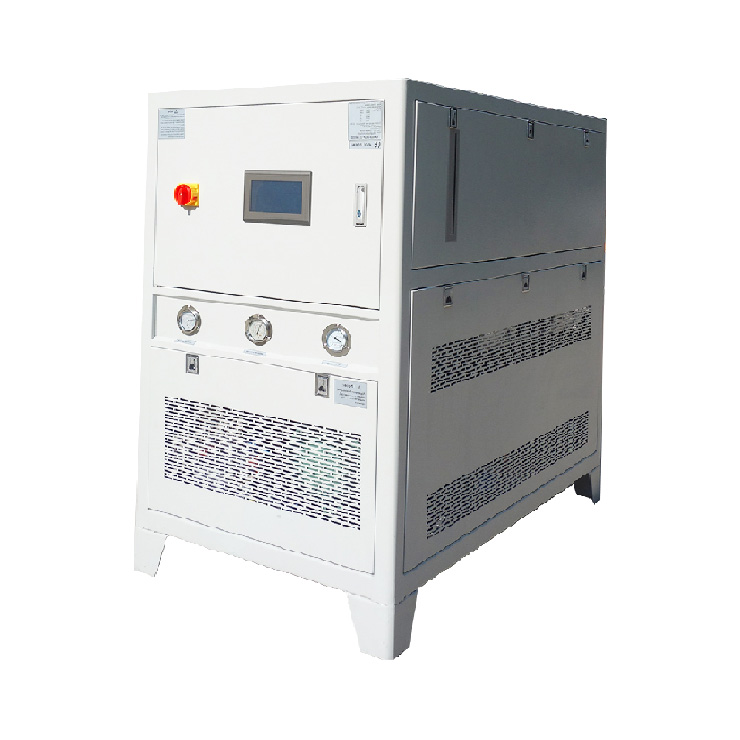
The REFTEK condensation capture refrigeration system is suitable for the condensation liquefaction recovery scenario of VOCs gases.
Connect VOCs gas or other electronic gases to the equipment through an induced draft fan, and separate them into a collection tank by reducing the temperature for liquefaction and capture. Other gases are emitted to achieve gas condensation, capture, and recovery.
The product has high refrigeration efficiency and rapid cooling, which can meet the needs of different condensation temperature ranges. The condensation temperature of the device is as low as -150 ℃.
Principle of Condensation Recovery
Working principle of refrigeration system: The high-temperature and high-pressure refrigerant gas discharged by the compressor enters the condenser and is condensed into high-pressure supercooled liquid. It is then throttled and depressurized by the expansion valve to become a mixture of low-temperature and low-pressure vapor and liquid, and then enters the evaporator (various stages of heat exchangers). The refrigerant absorbs the heat of the heat transfer medium inside and evaporates, vaporizes, and is then sucked into the compressor to enter the next cycle. The thermal conductive medium is transported to the VOCs gas condensation cold box through a circulating pump for heat exchange with the VOCs gas. The entire system continuously cycles through the above process to achieve the goal of continuous cooling, liquefaction, and recovery of VOCs gas.
VOCs gas condensation principle: The gas is cooled by transferring heat to the refrigerant in the condensation heat exchanger. By utilizing the difference in saturated vapor pressure of the substance at different temperatures, the process gas reaches a supersaturated state and condenses into liquid for direct recovery. Some of the gas enters the next stage unit for further treatment.
Application scenarios:
Low temperature condensation, capture and recovery of gases in industries such as chemical, pharmaceutical, semiconductor, automotive manufacturing, printing, and environmental engineering.
Used for VOCs gas single or multiple material condensation recovery:
Hydrocarbons: such as gasoline, crude oil, fuel oil, kerosene, diesel, heavy oil, mixed hydrocarbons, etc;
Aromatic compounds: benzene, toluene, xylene, styrene, naphtha, etc;
Alcohols, ethers, ketones, esters, etc.